Subterranean termite treatment addresses hidden infestations of Eastern subterranean termites, which cause over five billion dollars in structural damage across North America annually according to the United States…
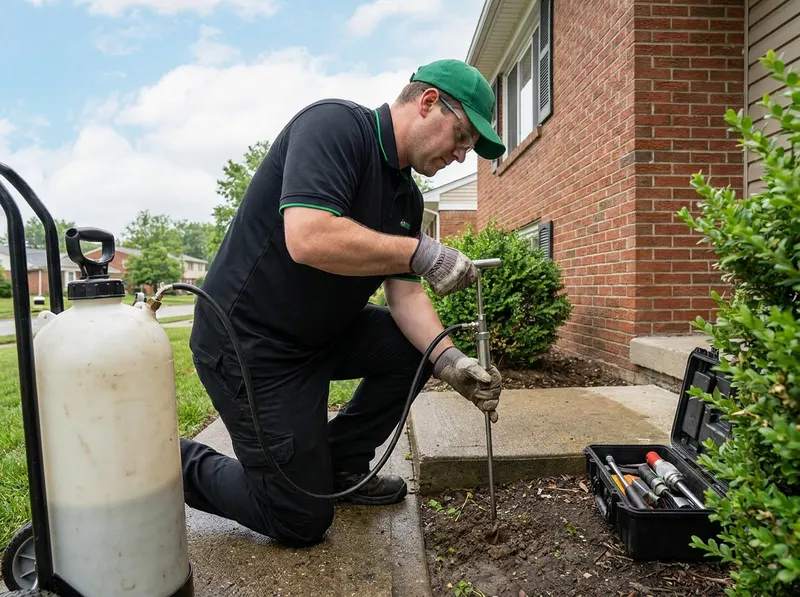
Subterranean termite treatment addresses hidden infestations of Eastern subterranean termites, which cause over five billion dollars in structural damage across North America annually according to the United States Environmental Protection Agency. In older communities such as Over-the-Rhine and Northside, unsealed rubble stone foundations and direct ground-to-wood porch attachments expose floor joists to silent feeding. Left unmanaged, these colonies consume springwood along the timber grain, hollowing out structural sills while leaving outer wood layers deceptively intact. Cincinnati's dense river valley moisture and high water table along the Ohio River provide continuous hydration to subterranean colonies nesting several feet beneath surface grade. In neighborhoods like Clifton, College Hill, and Pleasant Ridge, clay soils retain moisture against foundation walls, creating an optimal pathway for shelter tubes to climb foundation cracks toward untreated subflooring.
Effective management relies on established Integrated Pest Management principles outlined by regional agricultural extensions rather than cosmetic topcoat sprays that disintegrate within weeks. The protocol combines mechanical disruption of mud shelter tubes with non-repellent liquid termiticides or in-ground station grids. Liquid termiticide barriers bind directly to soil particles around foundation footings, adhering to the guidance established under the Federal Insecticide, Fungicide, and Rodenticide Act. As worker termites forage through the treated soil matrix, they ingest and transfer the active ingredient back to the central queen via social grooming, causing systematic colony collapse within 60 to 90 days. For structures in Mount Adams or Mount Lookout built upon steep rock outcroppings, localized in-ground bait matrices provide targeted suppression without disrupting delicate slope grades.
The trade-off between liquid chemical soil barriers and perimeter bait matrices centers on immediate structural protection versus site accessibility. Liquid perimeter treatments form a continuous defensive band around every linear foot of a foundation, requiring concrete drilling through basement slabs and trenching along foundation walls. This method achieves immediate structural defense along sill plates but requires substantial access along finished walls. Bait stations avoid interior slab drilling, relying on quarterly monitoring visits where bait cylinders containing chitin synthesis inhibitors are inserted once feeding occurs. In historic Hyde Park and Oakley properties featuring finished basements or mature perennial gardens, station arrays protect architecture and landscape roots while systematically eliminating colonies at the property border.
GraniteHaven Pest Solutions executes structural defense through a five-stage operational standard:
All chemical applications follow strict environmental safety thresholds set by the Ohio Department of Agriculture Pesticide Regulation Section and structural standards from the National Pest Management Association. Non-repellent barriers bind to the substrate and do not off-gas volatile compounds into living areas, ensuring safety for indoor pets and children once dry. Soil moisture management around gutters and downspouts works in tandem with chemical barriers, adhering to recommendations from the Ohio State University Extension. For homes near regional water resources or municipal parks like Eden Park or Spring Grove Cemetery and Arboretum, bait configurations protect local groundwater reserves in accordance with USGS Water Resources standards and runoff regulations supervised by the Ohio Environmental Protection Agency. Remediation plans do not force homeowners into multi-year recurring billing models, operating instead on verified structural restoration and honest inspections. Structural integrity data references standard testing benchmarks published by the ASTM International committee on building performance and moisture mitigation guidelines verified by the U.S. Department of Housing and Urban Development. Call (513) 812-8076 to schedule a formal evaluation.
Every job gets a firm, written price after an on-site visit.
Tell us about your subterranean termite treatment job in Cincinnati and we'll send a clear, written quote, usually the same day.
 GraniteHaven Pest Solutions