Discovering an active stinging insect nest near an entryway or under roof decking transforms a backyard into a hazardous zone, particularly for households with curious toddlers or domestic pets. According to guidelines…
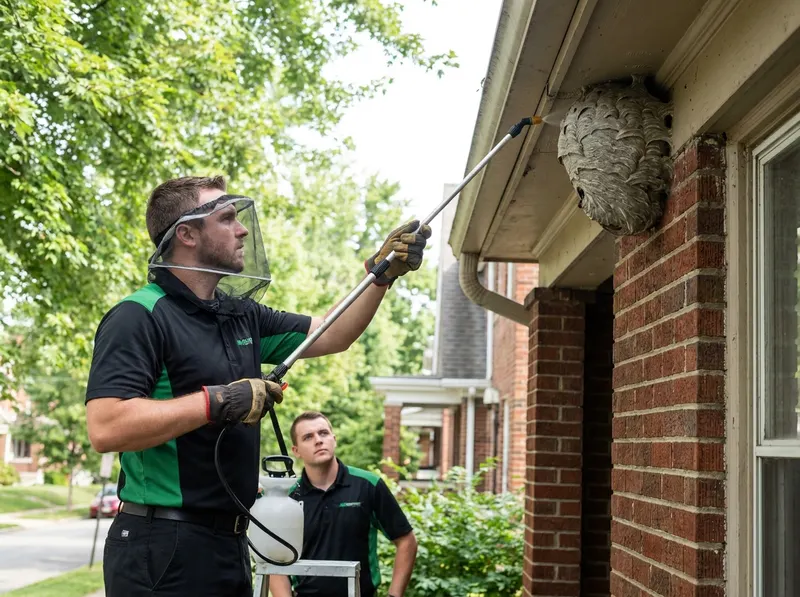
Discovering an active stinging insect nest near an entryway or under roof decking transforms a backyard into a hazardous zone, particularly for households with curious toddlers or domestic pets. According to guidelines set by the National Institute for Occupational Safety and Health, insect stings induce severe systemic allergic reactions in up to 5% of the population, making quick, objective mitigation a health priority. Retail aerosol sprays frequently disperse colonies deeper into siding voids rather than eliminating the queen. GraniteHaven Pest Solutions treats an infestation as an acute structural health event. Service protocols isolate the nesting hub using pyrethroid-based knockdowns regulated under the Environmental Protection Agency, neutralizing defensive flight within minutes to shield residents from territorial swarms.
In older multi-story homes throughout Clifton, Hyde Park, and Mount Lookout, colonies routinely establish inside exterior architectural cavities. Paper wasps build open-comb umbrellas under deep Italianate eaves, while yellowjackets take advantage of uncaulked gaps along soffit vents, brick weep holes, and rooflines. For internal wall-void infestations, surface fogging is ineffective because the hive envelope insulates the reproductive core. Instead, technicians drill fine 1/8-inch access points directly into the pocket or access entry channels identified via thermal detection, applying micro-pulverized insecticidal dust approved by the Ohio Department of Agriculture. This material attaches to foraging workers, transferring active ingredients throughout the brood chamber without releasing volatile fumes into finished interior spaces.
Structural landscape elements throughout Pleasant Ridge, College Hill, and Northside create microclimates that invite ground-nesting and timber-boring pests. Aerial bald-faced hornets suspend football-sized cellulose nests within dense mature tree canopies, such as those bordering Eden Park and the Cincinnati Zoo & Botanical Garden. Ground-nesting yellowjackets often repurpose abandoned chipmunk burrows along railroad tie retaining walls or landscaped berms. Treatment choices depend strictly on nest accessibility: exposed aerial combs require direct freeze-knockdown and complete physical removal, whereas subterranean colonies necessitate deep pressurized sub-surface injections to neutralize nursery cells. The trade-off between physical removal and chemical dust void treatment centers on property repair; an exposed nest can be stripped cleanly on day one, while an interior wall nest requires leaving the comb undisturbed for 48 hours to ensure returning foragers contact the residual matrix before exterior entry sealing occurs.
For homeowners experiencing stinging insect pressure, remediation follows a defined 5-step operational protocol: Step 1 is an exterior structural audit to track flight patterns and identify the exact nesting genus. Step 2 is species-specific knockdown using targeted mechanical isolation equipment or localized formulations. Step 3 is complete physical extraction of the exposed comb, carton, or hive mass whenever structurally accessible. Step 4 is localized entry-point mapping, identifying gaps along the building envelope where insects penetrated. Step 5 is the application of residual repellent dust to surrounding voids to inhibit pheromone-driven re-colonization.
Every job gets a firm, written price after an on-site visit.
Tell us about your stinging insect and wasp nest removal job in Cincinnati and we'll send a clear, written quote, usually the same day.
 GraniteHaven Pest Solutions