Rodent activity inside living quarters presents clear health hazards through airborne pathogens, food contamination, and electrical fire risks from chewed wiring. The National Pest Management Association notes that…
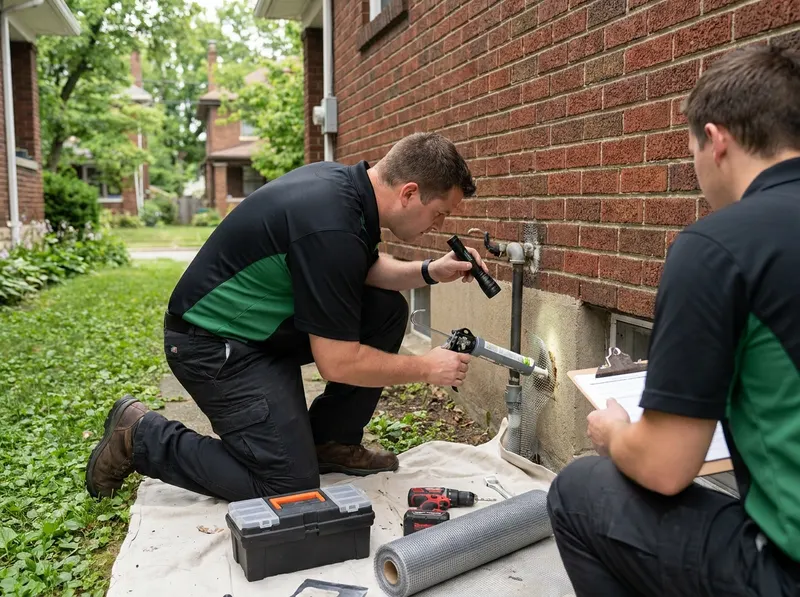
Rodent activity inside living quarters presents clear health hazards through airborne pathogens, food contamination, and electrical fire risks from chewed wiring. The National Pest Management Association notes that rodents invade roughly 21 million American homes each winter, frequently entering through gaps as narrow as 1/4 inch. For homes in Hamilton County, local topography and architectural diversity directly shape rodent pressure. In historic brick structures across Over-the-Rhine and Clifton, settling rubble foundations, limestone mortar gaps, and shared party walls give Norway rats easy access to interior subfloors. Further east, wooded ravines and mature tree canopies in Mount Lookout, Hyde Park, and Mount Adams provide natural travel corridors for roof rats to breach soffits, fascia boards, and gutter lines. Urban single-family properties in Northside, Oakley, College Hill, and Pleasant Ridge frequently encounter house mice infiltrating crawl space vents, basement windows, and exterior utility penetrations around air conditioning lines.
Over-the-counter snap traps and retail rodenticides rarely solve chronic nesting because they fail to address structural vulnerabilities. Surface-applied retail poisons leave poisoned rodents to perish inside drywall cavities, creating severe odor issues, secondary insect blooms, and secondary poisoning risks for household pets. The Centers for Disease Control and Prevention confirms that rodents transmit over 35 diseases worldwide, including hantavirus and lymphocytic choriomeningitis, which spreads through aerosolized urine, droppings, and nesting material. Effective structural defense relies on the principles of integrated pest management outlined by the United States Environmental Protection Agency, prioritizing non-chemical physical barriers over repeated chemical saturation. Rodents gnaw continuously on structural framing and wiring; the our team documents that unaddressed rodent chewing on electrical conductors poses a recognized structure fire hazard. GraniteHaven Pest Solutions executes deliberate physical exclusion to mechanically block these hazards permanently.
Restoring safety to an infested residence follows a strict five-step structural remediation process:
Choosing full structural exclusion over recurring retail poison contracts represents an explicit engineering trade-off. Routine poison-bait programs feature lower initial visit costs but require perpetual quarterly billing and create recurring risks of dead animal odors behind walls. Permanent physical exclusion carries a higher initial investment in labor and materials, such as structural steel grating and masonry mortar work, but it physically prevents future colonies from re-entering the building envelope. This structural integrity approach aligns with residential energy-efficiency and air-sealing guidelines supported by the U.S. Department of Energy, sealing drafts while establishing permanent pest boundaries. Building materials meet the non-combustible building standards managed by the International Code Council. Professional wildlife and rodent handling procedures further conform to standard wildlife damage management guidelines established by the Ohio Department of Natural Resources Division of Wildlife and the structural pest guidelines overseen by the Ohio Department of Agriculture.
Every job gets a firm, written price after an on-site visit.
Tell us about your residential rodent exclusion and removal job in Cincinnati and we'll send a clear, written quote, usually the same day.
 GraniteHaven Pest Solutions